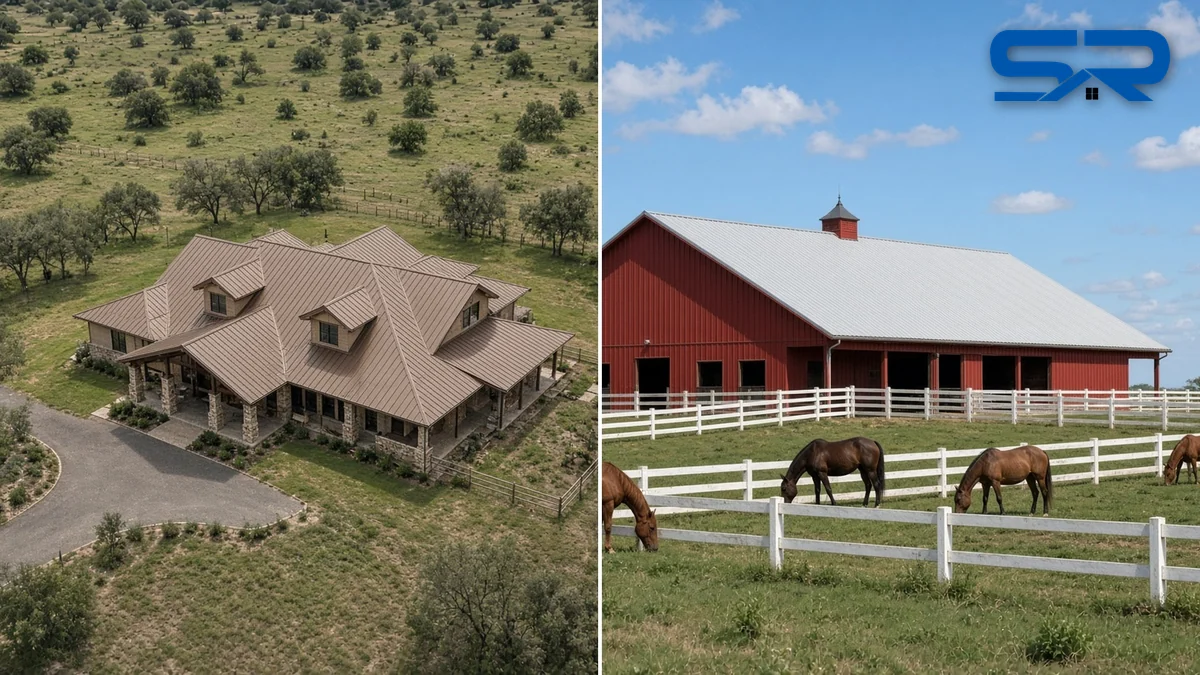
Drive a few miles off I-35 around Sanger and you’ll see why metal is the default roof out here. A brick or stone house sits up front, a horse barn or hay barn sits behind it, and somewhere there’s a shop, a carport or a covered arena. Each of those buildings needs a roof, and they don’t all need the same one.
I’m Blake Snow. I’ve been roofing for 30 years, I’m the third generation in a family business that goes back 75 years, and our crews have completed over $80 million in roofing projects. We form standing seam and R-panel on our own roll formers in 24 or 26 gauge, and our own crews install them. We also offer corrugated and PBR panels. This post is the plain-English version of how I’d pick the metal for each building on a Sanger property.
The short answer
- House: standing seam over solid decking. Hidden clips, no exposed screws, clean look.
- Open barn, hay barn, equipment shed: R-panel or PBR on purlins. Strong, economical, easy to repair.
- Shop, horse barn with a tack room, or a barndominium: R-panel or PBR with real condensation control, or standing seam if it’s living space or sits in full view of the house.
- Gauge: 26 gauge is the common choice; 24 gauge is heavier and dents less.
- Around Sanger, plan for wind first. NOAA’s records near town are full of barn roofs that blew off.
Pick the panel by the building, not the brochure
| Building | Panel I’d usually recommend | What it goes over | Why |
|---|---|---|---|
| House | Standing seam | Solid decking and high-temp underlayment | No exposed fasteners, sharpest look, best for living space |
| Open hay barn or equipment shed | R-panel or PBR | Open purlins | Spans supports, lowest cost per square foot, simple repairs |
| Horse barn (stalls, tack, feed) | R-panel or PBR, sometimes standing seam | Purlins with a vapor-control layer or insulation | Horses put moisture in the air; bare steel drips without it |
| Shop or garage | R-panel or PBR | Purlins, insulated if heated or cooled | Durable, matches most metal buildings |
| Barndominium or shop with an office | Standing seam or R-panel with full insulation | Decking or insulated assembly | It’s a house now, so treat the roof like one |
| Covered arena or long pole barn | R-panel or PBR in long runs | Purlins | Long one-piece panels, edges fastened for wind |
| Porch or carport next to the house | Standing seam to match the house | Decking | Same panel and color as the main roof |
The mistake I see most often is the opposite of what you’d expect: not cheap panels on a barn, but exposed-fastener panels on a house to save money, or bare panels on a closed-in barn that then sweats on everything inside. Get the building right and the panel choice is easy.
For more on the barn side, see our barn roofing in Sanger page, and for living-space outbuildings, our page on barndominium, shop and ag building roofs.
Standing seam on a Sanger house
Standing seam is what most homeowners picture when they say “metal roof.” The panels run ridge to eave with raised seams, and the clips that hold them down are hidden under those seams. A few things make it worth it on a house:
- No exposed screws. On a screw-down roof, rubber washers age in the Texas sun and need attention over the years. Standing seam doesn’t have that maintenance item.
- The panels can move. Steel grows and shrinks with heat. Clips let the panels move without working holes loose.
- One piece per run. Because we form panels on site, each panel is cut to the exact length of its run, with no end laps on most roofs.
- Details matter more than the panel. Hips, valleys, walls and chimneys get formed trim and proper flashing. That’s where metal roofs leak when they leak.
A real example: we replaced the shingle roof on a red-brick ranch home on acreage between Sanger and Valley View with a dark standing seam roof. It had several hips plus a garage, entry and a roof over the pool and spa, and the panels were formed in-house. If your house has a lot of hips, look at that project for what clean hip trim should look like.
Our standing seam in Sanger page covers the system in more detail, and my post on switching from shingles to standing seam walks through tear-off to final trim.
Barn and shop metal: R-panel, PBR and corrugated
R-panel and PBR are exposed-fastener panels with tall ribs, made to span open purlins. PBR has an extra purlin-bearing leg at the lap, which helps the overlap sit tight on the support. Corrugated is the classic wavy panel some owners want on an old-style barn.
What matters on a barn roof near Sanger:
- Fastener pattern. Screws at the right spacing, with heavier fastening at the eaves, rakes and ridge, where wind pulls hardest.
- Closures and trim. Foam closures at eave and ridge keep out birds, wasps and wind-driven rain.
- Translucent panels. Old skylight panels go brittle and crack. Replace them with the roof.
- Condensation. Any barn you close in, especially one with horses, needs ventilation and a vapor-control layer or insulation under the steel.
If your barn roof is old but sound, it may only need new screws. I explain that call on the barn roofing in Sanger page, and I’ll tell you honestly if a re-screw will do.
24 vs. 26 gauge
Lower gauge number means thicker steel. We run both:
- 26 gauge is the common choice for houses, barns and shops in North Texas.
- 24 gauge is heavier and stiffer. It dents less in hail and keeps wide, flat standing seam panels looking flatter. I suggest it when looks or hail worry you most.
Either way, ask about the paint system on the panel and the warranty that comes with it, and get the gauge written on your estimate. My older post on 26 vs. 29 gauge explains why I don’t use thinner steel on roofs.
Plan for Sanger’s wind and hail
From NOAA’s Storm Events Database, the storms around Sanger read like a list of what happens to barns:
- July 31, 2025: a microburst near FM 922 and FM 2848 in Valley View, about eight miles northwest, tore the roof off a barn, with debris scattered over 1.2 miles.
- June 8, 2025: a trained spotter measured an 82 mph gust near the same intersection north of Sanger.
- March 4, 2025: about five miles from town, wind lifted a grain silo and blew it about 300 feet.
- July 10, 2019: part of a barn’s metal roof was peeled off near Era, roughly ten miles northwest.
- June 15, 2023: 5.9-inch hail just southeast of Sanger, based on a National Weather Service storm survey. It’s the largest hail NOAA lists anywhere in Denton County from 2016 through its September 2026 update.
What I do about it: fasten edges and ridges heavier than the field, make sure purlins and trusses are sound before new panels go on, use formed trim at every edge, and on open-sided barns pay extra attention to the eave that faces the wind. For hail, heavier gauge and a textured or striated panel hide marks better than thin, smooth, dark steel.
If a storm already came through, start with our Sanger storm damage page. Every estimate starts with a free digital photo report. In Texas you generally have 1 year from the date of loss to file a claim, but check your policy.
Permits: city, county, or lake
Where your property sits decides the paperwork:
- Inside Sanger city limits. The City’s permits page lists a Re-Roofing Permit, and all permit applications are filed online through Community Core by a contractor registered with the City. Registrations run January through December 31 each year. The City posted a new fee schedule effective October 1, 2026, so we confirm the current fee when we file. New barns or shops in town are accessory buildings and go through Building Inspection.
- On county land. A lot of acreage with a Sanger address is outside the city. There, Denton County’s Development Services department requires a Development Permit for any new building or structure in unincorporated areas.
- Near Lake Ray Roberts. The county also enforces a land use ordinance around the lake, so we check that before building anything new close to it.
We check your tract and handle the permit. Ask any roofer who bids to show you the permit before work starts.
Questions to ask before you sign
- Which panel for each building, and why?
- What gauge, and is it written on the estimate?
- Are panels one piece ridge to eave, or lapped?
- What’s the fastener pattern at edges and ridge on the barn?
- How will you control condensation in any closed-in building?
- Who installs it: your own crew or a sub?
- Who pulls the permit, city or county?
- What workmanship warranty do you give, in writing?
Why Sanger property owners call us
- Our own roll formers and our own crews for standing seam and R-panel, 24 or 26 gauge.
- Metal lead time is typically 1 to 2 weeks.
- Certified with GAF, CertainTeed, Owens Corning, Atlas, Johns Manville, Carlisle, Tropical Roofing Products, Mule-Hide and Enviroshake, and many other roof manufacturers.
- 5.0 stars on Google at all three offices: Bridgeport, Decatur and Rhome.
- BBB A+ rated and fully insured.
- Workmanship warranty from 10 years up to lifetime, depending on the job.
See our full metal roofing in Sanger page. Doing siding or windows too? We also handle siding in Sanger and window replacement in Sanger. Nearby, read my post on R-panel and standing seam in Krum and on equestrian barns and arenas. We also work in Valley View, Krum, Denton, Pilot Point, Aubrey and Gainesville.
Get a metal roof estimate around Sanger
Tell me what’s on your property: the house, the barn, the shop. I’ll bring real samples of standing seam, R-panel and PBR in 24 and 26 gauge and price each building so you can decide. Every estimate starts with a free digital photo report. Request an estimate or call (817) 733-9228.