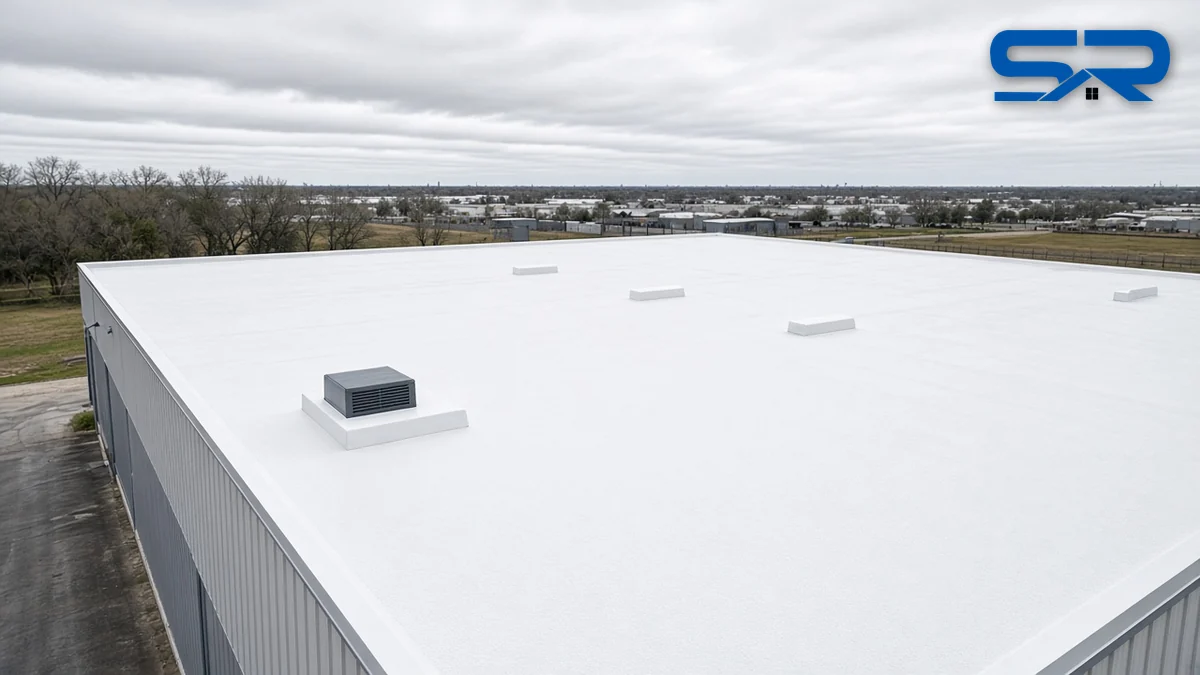
Fort Worth has a lot of big, flat, sun-baked roofs: distribution warehouses up the I-35W and Alliance corridor, strip centers on the west and south sides, older offices with spray foam roofs, and metal buildings everywhere in between. When those roofs are still sound but tired, a silicone coating is often the smart, lower-disruption fix. And if you’re getting coating bids around Fort Worth, you may see the AldoSil name.
I’m Blake Snow. I’ve been roofing for 30 years, and we’ve worked with Inland’s AldoSil silicones along with the other coating lines we install. This post compares the two AldoSil field coatings, AldoSil 397 (high-solids) and AldoSil 395 (low-solids), using Inland’s own current data sheets and design guidelines, so you can tell which one fits your roof and what a fair bid should spell out.
First: who makes AldoSil now?
AldoSil started at ALDO Products in North Carolina. ALDO became part of Inland Coatings in 2019, and in early 2025 the ALDO, TRUCO and Inland names were folded into one brand: Inland. The product names stayed. Inland’s 2026 silicone sell sheet and data sheets still list AldoSil 397 and AldoSil 395, so if a bid says “ALDO” or “AldoSil,” it’s the same family, now sold under Inland Coatings.
The short answer
- Most Fort Worth warehouses, metal buildings and aged single-ply roofs: AldoSil 397. It’s the high-solids product, goes on in one coat (Inland says over 40 wet mils without blistering), and it’s the field coating Inland lists in its current warranty guidelines.
- Spray foam (SPF) roofs, rough surfaces, and touch-up or recoat work: AldoSil 395 is worth a look. Inland describes it as known for its adhesion and its ability to fill voids and surface imperfections, and calls it a preferred choice for spray foam roofs.
- Either way, the roof has to be sound, dry and draining. Inland’s guidelines say so in writing. A coating doesn’t fix wet insulation or a sagging deck.
AldoSil 397 vs. AldoSil 395: Inland’s published numbers
| AldoSil 397 (High-Solids) | AldoSil 395 (Low-Solids) | |
|---|---|---|
| Type | One-part, moisture-curing silicone | Solvent-based, moisture-curing silicone |
| Solids by weight | 94% | 82% |
| Solids by volume | 92% | 68% |
| Weight per gallon | 11.8 lb | 11.3 lb |
| Elongation | 164% (ASTM D2370) | 186% (ASTM D412) |
| Tensile strength | 336 psi (ASTM D2370) | 551 psi (ASTM D412) |
| VOC | Under 50 g/L | 246 g/L |
| Solar reflectance (white, initial) | 0.82 | 0.87 |
| Thermal emittance (white, initial) | 0.91 | 0.90 |
| SRI (white, initial) | 103 | 113 |
| Typical minimum application | One coat at 24 wet mils | Two coats at 16 wet mils |
| Colors | White, tan, gray, black | White, tan, gray, black |
| Packaging | 1-gal (case of 4), 5-gal, 50-gal | 5-gal, 50-gal |
| Shelf life | 24 months | 24 months |
Source: Inland’s AldoSil 397 technical data sheet and AldoSil 395 technical data sheet. Inland notes results may vary by ±10%. Note the elongation and tensile numbers use different ASTM test methods, so don’t compare them head to head.
What those numbers mean on a real roof
Solids decide how much coating actually stays on the roof. When the solvent leaves, a 92%-solids coating keeps almost all of its wet thickness. A 68%-solids coating keeps about two-thirds. Do the math on Inland’s numbers: to end up with about 22 dry mils, you need roughly 24 wet mils of 397 but about 32 wet mils of 395. That’s around a third more product, and usually an extra coat. On a 100,000 sq. ft. Fort Worth warehouse, that difference shows up in the material and labor lines of the bid.
Reflectance is a little better on 395, at least on day one. Inland lists 395 white at 0.87 initial solar reflectance and SRI 113, versus 0.82 and SRI 103 for 397. Both are bright white roofs. Neither data sheet publishes 3-year aged values, and silicone picks up dirt over time, so don’t make your decision on initial SRI alone.
VOC matters on occupied buildings. 395 is solvent-based at 246 g/L. 397 is under 50 g/L. On a medical office, school, or a retail center with rooftop air intakes, we plan for odor either way (shutting down or protecting intakes), but the lower-VOC product makes that job easier.
395’s selling point is how it wets out and fills. Inland says 395 is known for superior adhesion and filling voids and surface imperfections, and calls it a preferred choice for spray foam roofs. That’s the job it’s built for.
What Inland’s warranty guidelines call for
Inland publishes design and application guidelines for each roof type. In the current guidelines for metal, spray foam, smooth BUR and mod bit, and TPO/PVC, the field coating listed is AldoSil 397, at these minimums:
| System warranty | AldoSil 397 rate | Wet mils | Minimum dry film |
|---|---|---|---|
| 10-year | 1.5 gal per 100 sq. ft. | 24 | 22 mils |
| 15-year | 2.0 gal per 100 sq. ft. | 32 | 30 mils |
| 20-year | 2.5 gal per 100 sq. ft. | 40 | 37 mils |
Source: Inland’s silicone metal roof design and application guideline and the matching spray foam, smooth mod bit/BUR and TPO/PVC guidelines.
Inland also says those are minimums, not averages, and don’t account for waste, application method or the roof’s texture. Other requirements from the same guidelines worth knowing:
- Adhesion test: documentation of a passing adhesion test is mandatory for any system warranty, with a minimum pull of 2 pounds per linear inch.
- Apply before you start: warranty applications must be submitted before the project begins, and Inland wants at least two weeks’ notice to schedule inspections.
- Full roof areas only (partial areas need Inland’s prior approval). Edge metal, wall panels and gutters are excluded, and system warranties aren’t available on residential projects.
- Ponding: the smooth BUR/mod bit and TPO/PVC guidelines add an extra 16 wet mils of silicone where water ponds.
If a bid quotes a “20-year AldoSil roof” with 395, or doesn’t state gallons per 100 sq. ft., ask which Inland guideline it follows. On the material data sheets themselves, Inland’s product warranty is a materials warranty (replacement of product proven defective), so the system warranty is the one that matters to an owner.
Where we’d use each one in Fort Worth
| Fort Worth roof | Our usual pick | Why |
|---|---|---|
| Galvalume or painted metal warehouse | AldoSil 397 | One heavy coat over sealed fasteners and seams; it’s the guideline product for metal |
| Aged white TPO on a distribution building | AldoSil 397 + TPO primer | Primer, adhesion test, then one coat at the warranty rate |
| Older spray foam roof on an office or shop | AldoSil 395 or 397 | 395 fills foam texture well; 397 is the product in Inland’s SPF warranty guideline |
| Smooth BUR or smooth mod bit on a strip center | AldoSil 397 + AldoBlock 708 | Bleed-blocking primer keeps asphalt from staining the white |
| Gravel BUR or alligatored asphalt | AldoSil 390 leveler, then 397 | Inland makes 390 to level surfaces too rough for direct coating |
The prep is where these jobs win or lose
Inland’s guidelines line up with how we already do it:
- Inspect and moisture-check. Wet insulation gets cut out and replaced. Coating over it traps water.
- Clean. Inland calls for a pressure washer with at least 3,000 psi working pressure. A clean white rag should come off the roof with no residue.
- Fasteners and seams on metal. Loose or stripped screws are tightened or replaced with oversized screws and neoprene washers, then every fastener is encapsulated in AldoSil 399 silicone mastic. Horizontal seams get mastic or a fabric-reinforced coating strip.
- Rust. Sound rusted areas get treated (Inland lists RRC-600 rust converter) and primed with AldoPrime 710. Rusted-through panels get replaced, not coated.
- Prime where needed: Inland’s TPO primer on aged TPO, AldoBlock 708 on asphalt surfaces.
- Coat with a wet-film gauge. Inland’s data sheets call for 50°F and rising, substrate no hotter than 130°F. In a Fort Worth August, that means early starts.
One practical note from the data sheets: don’t spray silicone through hoses that were used for acrylic. Mixed chemistries cause problems, and a good crew keeps separate equipment.
When a coating is the wrong answer
- Wet roof: if a moisture survey shows widespread wet insulation, it’s time for a tear-off or partial replacement.
- Hail-fractured membrane: get it documented and repaired first. Our FAA-certified drone pilot can fly the roof; see our drone roof inspection page.
- Rusted-through metal: that’s a re-panel job. We run our own roll formers for 24- and 26-gauge R-panel and standing seam, and offer PBR and corrugated panels, with a typical lead time of 1 to 2 weeks.
More on that decision on our roof coating vs. replacement page.
Other coatings we bid side by side
Inland isn’t the only option. We’re certified with Mule-Hide and Tropical Roofing Products, both of which make coatings, we’re an American WeatherStar Approved Contractor, and we offer EpoxyFlex, our own private-label roof coating. For comparisons, see my Mule-Hide silicone vs. acrylic post, my Karnak coatings post for metal and low-slope roofs, and my post on coatings for old built-up roofs in Fort Worth. If you’re weighing Inland’s acrylic or polyurethane lines instead, read my AldoCoat 400S vs. AldoThane 384/386 post.
Questions to ask before you sign a silicone bid
- Is it AldoSil 397 or 395, and why that one for my roof?
- How many gallons per 100 sq. ft., and what minimum dry film will you leave?
- Was an adhesion test done, and did it meet Inland’s 2 PLI minimum?
- Which primer (TPO primer, AldoBlock 708, AldoPrime 710), if any?
- How are fasteners, seams and penetrations handled?
- Was a moisture survey done?
- Is there an Inland system warranty, how many years, and was it applied for before work starts?
- What’s the plan for ponding areas, rooftop air intakes and weather?
After a storm
Get the roof inspected and documented before anyone coats it. A coating is not a hail repair. Check storm history for Tarrant County in the NOAA NCEI Storm Events Database. In Texas it’s generally 1 year from the date of loss to file a claim, but check your policy.
Talk to us about a coating in Fort Worth
We coat and restore commercial roofs across Fort Worth, Haslet, Saginaw, White Settlement, Benbrook and North Richland Hills. We’re certified with GAF, CertainTeed, Owens Corning, Atlas, Johns Manville, Carlisle, Tropical Roofing Products, Mule-Hide and Enviroshake, and many other roof manufacturers. Commercial jobs can carry 10- and 20-year NDL warranties, and our workmanship warranty runs from 10 years up to lifetime, depending on the job. We’re fully insured, BBB A+ rated, and have 5.0 stars on Google at all three offices: Bridgeport, Decatur and Rhome.
See our silicone roof coating page, spray foam roofing page and Fort Worth commercial roofing page, use the estimate form below, or call (817) 733-9228.
Sources
- Inland: AldoSil 397 product page and technical data sheet
- Inland: AldoSil 395 product page and technical data sheet
- Inland: Silicone roof coatings sell sheet (2026)
- Inland: Technical documents and design guidelines
- Inland: Silicone metal roof design and application guideline
- CoatingsPro (AMPP): ALDO joins Inland Coatings (2020)
- NOAA NCEI Storm Events Database