
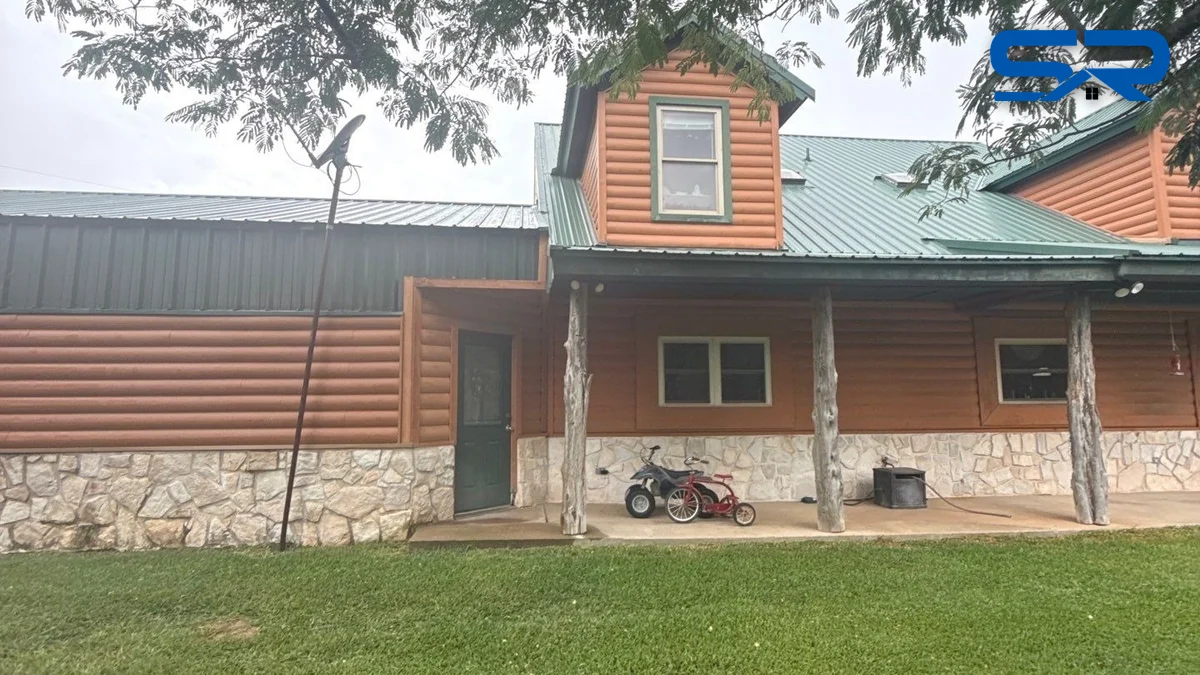
Standing seam for country homes in Perrin, TX is the roof I’d put on most ranch houses out here. Perrin sits on open Keechi Valley prairie along U.S. 281 in south-central Jack County, and a country home there takes straight-line wind, hail and hot sun with nothing around to slow any of it down. Standing seam handles all three, with no exposed screws to fail.
I’m Blake Snow. I’ve been roofing for 30 years, I’m the third generation in a family business that goes back 75 years, and our crews have completed over $80 million in roofing projects. Our Bridgeport office is about 40 road miles from Perrin, roughly a 51-minute drive. We form our own standing seam panels on our own roll formers, and our own crew installs them. Here’s how I’d plan a standing seam roof on a Perrin country home.
The short version
- Standing seam is the long-term house roof. Fasteners hide under the seam, and clips let the steel move.
- Gauge: every metal roof we install is 24 or 26 gauge steel.
- Wind is the everyday test on open prairie. Eaves, rakes, ridges and porches are where it’s won or lost.
- Hail is on the record here. NOAA lists golf-ball hail at Perrin and a 3.25-inch stone in nearby Joplin.
- Country homes have more than a main roof: porches, dormers, a wood stove pipe, a carport or a shop.
- Lead time: typically 1 to 2 weeks for metal.
Why standing seam suits a Perrin country home
Perrin is small and unincorporated. TSHA dates it to around 1870 and notes its population has generally stayed between 300 and 350. Most homes around it sit on acreage, often with long views and few trees close in. That setting changes how a roof should be built:
- Wind hits the house straight on. Uplift at the edges is what takes metal roofs apart, not the middle of the panel.
- Big temperature swings. Steel grows and shrinks every day in a Texas summer. A roof that’s pinned tight with screws works itself loose over the years. Standing seam is built to move.
- You want to be done with it. Folks out here don’t want a roofer back every few years. Hidden fasteners mean less to check.
Clips, seams and panels: what actually makes it last
This is the part most metal roof pages skip, and it’s where the money goes.
Clips, not screws through the panel
A standing seam panel is held down by clips screwed to the deck. The clip sits under the seam, out of the weather. Many systems use floating clips that let each panel slide a little as it heats and cools, with the panel pinned at one point so it can’t walk downhill. That’s why standing seam doesn’t get the slotted, wallowed-out screw holes you see on old exposed-fastener roofs. Clip spacing follows the panel maker’s schedule, and it gets tighter at the edges where wind pulls hardest.
Snap-lock or mechanically seamed
- Snap-lock seams click together by hand. They’re clean, fast and a great fit for most country homes with a normal pitch.
- Mechanically seamed panels are folded shut with a seaming tool after they’re set. That locked seam holds better on low-slope porch roofs and very exposed spots.
Plenty of houses get snap-lock on the main roof and a mechanically seamed porch. Here’s the full snap-lock vs. mechanical lock comparison.
One panel from ridge to eave
Because we roll form our own panels, most roof planes get one piece of steel from ridge to eave. No end laps means no sideways seams for wind-driven rain to work into. On a 51-minute drive from our shop, that matters: we don’t have to haul long panels down country roads and hope they arrive straight. More on that in our long panel runs guide and why we form metal panels on site.
Panel width and oil canning
Wide, flat panels can show waviness in bright sun, called oil canning. It doesn’t leak, but on a house you look at every day it bugs people. Narrower panels, striations or pencil ribs in the flat, a solid flat deck and correct clip spacing all help. We’ll talk through which look you want before we form anything.
The parts of a country home that need extra care
The main roof is the easy part. These are the details I check on every Perrin-area house:
- Front and back porches. Often lower slope than the house, sometimes on cedar posts, and wide open underneath, so wind pushes up from below. They get the right seam type for the slope and extra fastening at the eave.
- Dormers and roof-to-wall joints. Every place a roof meets a wall gets flashing tucked behind the siding, not caulked on top of it. See metal roof flashing details.
- Wood stove and fireplace pipes. Pipes go in the high part of a panel with a flashing boot made for metal, or get a cricket to split water around a chimney.
- Valleys. Valleys carry the most water. We run full-length valley metal under the panels.
- Underlayment. Under standing seam on a house we use a synthetic or high-temperature underlayment, so the house stays dry even if a panel is ever damaged.
- Ventilation and attic heat. Ridge vents and soffit intake keep the attic cooler under steel and help with condensation. If you have a barndo-style living space, read condensation control under a metal roof.
Hail and wind near Perrin: what NOAA shows
I only quote storm records I can point to. NOAA’s Storm Events Database lists:
- Golf-ball-size hail on March 26, 2017, reported near FM 2210 and Pump Station Road, about 3 miles northwest of Perrin.
- Golf-ball-size hail on May 7, 2020, reported about a mile east of Perrin on FM 2210.
- A 3.25-inch hailstone in Joplin on May 17, 2025, from a storm chaser photo, in the same storm that brought an estimated 70 mph wind there.
- Thunderstorm wind damage in Perrin on September 21, 2025. NOAA’s note says metal and lightweight structures sustained damage.
- 17 reports of golf-ball-size or larger hail in Jack County in NOAA’s records since 2016.
That September 2025 note is the one I’d pay attention to. Wind damage on metal usually starts at a loose edge: a rake trim that wasn’t fastened enough, a ridge cap that lifted, a porch roof with open eaves. Tie those down right and the panels stay put.
Hail that size can dent steel, but it rarely punches through 24 or 26 gauge the way it cracks shingles. A dented standing seam roof usually still keeps water out. Whether cosmetic dents count on your claim depends on your policy, so read the wording before you buy. Metal roofs and hail covers it.
If a storm already came through, we’ll do a free storm and hail inspection with a digital photo report. In Texas you generally have 1 year from the date of loss to file a claim, but check your policy.
Standing seam or R-panel?
| Standing seam | R-panel / PBR | |
|---|---|---|
| Fasteners | Clips hidden under the seam | Exposed screws through the panel |
| Heat movement | Panels float on clips | Screws hold panels tight |
| Upkeep | Very little | Screws and washers checked over the years |
| Look | Clean vertical lines | Ribbed, ranch and ag look |
| Best fit | Houses and porches you’ll keep | Shops, barns, simple houses on a budget |
| Cost | Higher | Lower |
R-panel is still a good roof, and we install plenty of it on shops and barns around Jack County. A common plan is standing seam on the house and R-panel or PBR in a matching color on the shop. If you’re doing both, read roofing the house and shop together and see barn roofing in Jacksboro. For the screw question in detail, see hidden fasteners vs. exposed screws.
Colors that fit a country home
Green, charcoal, dark bronze, barn red and galvalume are all common out here. Match the roof to the stone and trim, not the paint chip. A darker roof on a cedar-post porch reads as “ranch house”; galvalume reads more farmhouse. See metal roof colors and finishes.
What drives the price
I won’t quote prices on a page, because every house is different. What moves the number: square footage, pitch, how many valleys, dormers and porches, tear-off layers, decking repairs, snap-lock vs. mechanically seamed, and trim and gutters. Our standing seam cost guide explains each factor. If you’re going from shingles to metal, here’s the step-by-step switch.
Gauge, lead time and warranty
- Gauge: 24 or 26 gauge steel on every metal roof we install. Here’s what the gauge number means.
- Lead time: our metal lead time is typically 1 to 2 weeks.
- Workmanship warranty: from 10 years up to lifetime, depending on the job, plus the manufacturer’s coverage on the materials.
We’re certified with GAF, CertainTeed, Owens Corning, Atlas, Johns Manville, Carlisle, Tropical Roofing Products, Mule-Hide and Enviroshake, and many other roof manufacturers. We’re fully insured, BBB A+ rated, and we have 5.0 stars on Google at all three offices: Bridgeport, Decatur and Rhome. References are available on request.
Questions to ask any standing seam installer in Jack County
- What gauge is the steel, and who forms the panels?
- Snap-lock or mechanically seamed, and why for each part of my roof?
- Fixed or floating clips, and what’s the clip spacing at the edges?
- Will each panel run ridge to eave in one piece?
- How are the porches, rakes and ridge fastened for wind?
- What underlayment goes under it?
- What’s the workmanship warranty, in writing?
- How soon can the metal be on site?
Perrin and south-central Jack County
We work in Perrin and across Jack County, including Jacksboro, Joplin and Bryson, plus nearby Graford, Boonsville and Mineral Wells. We’ll come out, measure every roof on the place and send you a free digital photo report.
Let’s look at your roof
Call (817) 733-9228 or use the free estimate form below. Tell us about the house, the porches and anything else on the property, and we’ll put together a standing seam plan for your Perrin country home.