
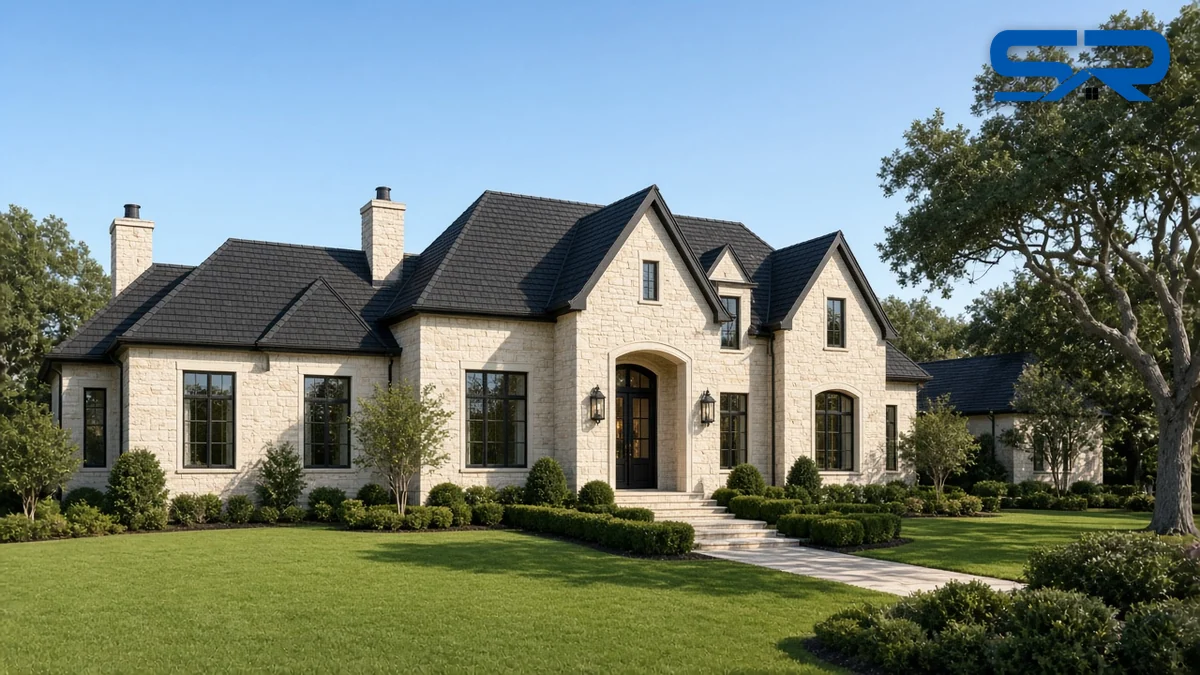
Upgrading a Prosper or Celina new build off its builder-grade roof usually comes down to two choices: standing seam metal or a designer Class 4 shingle. You bought a newer home in a fast-growing part of Collin County, the house is exactly what you wanted, and the roof is whatever the builder put on to hit a price. Now you’re asking whether to live with it, or move up to something built for North Texas hail that also looks the part.
I’m Blake Snow. I’ve been roofing for 30 years, I’m the third generation in a family business that goes back 75 years, and our crews have completed over $80 million in roofing projects. We run our own roll formers for standing seam, and we install Class 4 impact-resistant shingles and designer shingles across Prosper, Celina and the rest of North Texas. Here’s how I walk a new-build owner through the decision.
The short version
- Find out what the builder installed. Brand, line, color and impact rating. Many production roofs have no impact rating at all.
- You don’t have to tear off a sound roof. Plenty of owners upgrade when the first real hail claim comes, and pay the difference for the better roof.
- Standing seam is the long-term, high-end move. 24- or 26-gauge steel, formed on site to the length of each slope, with a clean modern or farmhouse look. It goes through HOA design review in most neighborhoods.
- Designer Class 4 shingles are the easier HOA path. Slate and shake looks, heavier shingles, the top UL 2218 impact rating, and protection under Texas Property Code 202.011 when they resemble approved shingles.
- Fix the details either way. Drip edge, flashing, ventilation and underlayment matter as much as the top layer.
- Get the paperwork right. TDI Form PC068 for a Class 4 roof, a permit in both towns, and the HOA letter before work starts.
If you already know you want standing seam and need to get it through your HOA, read HOA approval for a specialty roof in Frisco and Prosper. This post is about the step before that: which roof to move up to.
What “builder-grade” usually means on a new home
“Builder-grade” isn’t a product name or a code term. It’s shorthand for the standard package a production builder puts on hundreds of homes. On a new house in a master-planned community, that’s often a standard architectural shingle in one of a few approved colors, installed to code. Nothing wrong with code. But code is a minimum, and a standard shingle without an impact rating is the roof that gets replaced first when a hailstorm comes through.
Before you decide anything, find out what you have:
- Look in your closing papers or builder warranty packet for the shingle brand, product line and color.
- Ask the builder if it isn’t written down. A warranty department can usually tell you.
- Check for a UL 2218 rating on that exact product. If it isn’t Class 3 or Class 4, it isn’t impact rated.
- Read the builder’s warranty and the shingle warranty before anyone tears off the roof, so you know what coverage you’re giving up.
- Get an inspection. A roof inspection usually takes 15 to 45 minutes, and we can do it without you home unless there are leaks we need to see from inside.
What I check on a newer roof
Newer roofs are often in good shape. When I find problems on a young roof, they’re almost always in the details, not the shingles.
| What I check | What I’m looking for | Why it matters at upgrade time |
|---|---|---|
| Drip edge at eaves and rakes | Present, lapped and fastened | Prosper’s re-roof guide requires drip edge on all asphalt shingle roofs |
| Step and counter flashing at walls | Correct laps, not just sealant | Second-story walls over lower roofs are a common leak spot on two-story homes |
| Valleys | Clean lines, no cut shingles too short | Complex rooflines on newer homes have a lot of valleys |
| Pipe boots and vents | Cracked boots, missing caps or screens | Prosper’s guide requires damaged vents to be replaced and proper vent terminations |
| Attic ventilation | Balanced intake and exhaust | Heat build-up shortens shingle life and can affect warranty coverage |
| Decking | Soft spots or delamination | Any bad decking gets replaced during the upgrade |
| Hail and wind marks | Bruising, granule loss, creased tabs | If there’s storm damage, the upgrade may start as a claim |
Standing seam vs. designer Class 4 shingles
Here’s the honest side-by-side. I lean standing seam on homes where it fits, but designer Class 4 shingles are a very good roof, and on some houses and in some neighborhoods they’re the right call.
| Standing seam metal | Designer Class 4 shingles | |
|---|---|---|
| Look | Clean vertical lines; modern, farmhouse, European and transitional styles | Slate, shake or heavy dimensional looks that blend with traditional brick and stone |
| Material | 24- or 26-gauge steel panels formed on our own roll formers | Heavyweight asphalt shingles, some made with SBS-modified (rubberized) asphalt |
| Impact rating | Many panels are tested to UL 2218 Class 4; ask for the listing on the exact panel | UL 2218 Class 4 on the products I’d recommend for this upgrade |
| How hail shows | Large hail can dent steel; it won’t crack like an asphalt mat | Resists cracking; very large hail can still damage it |
| HOA path | Usually design review; shingles-only statute doesn’t name metal | Easier; Property Code 202.011 protects impact-resistant shingles that resemble approved shingles |
| Low-slope sections | Standing seam can go lower than shingles where the panel maker allows | Asphalt shingles need at least 2:12 under the IRC, with extra underlayment below 4:12 |
| Lead time | Typically 1 to 2 weeks for metal once the color is picked | Depends on product and color availability |
| Insurance paperwork | Ask your carrier how it treats metal and cosmetic dents | TDI Form PC068 for the Class 4 credit, if your insurer offers one |
| Best fit | You plan to stay, the HOA allows it, and you want the clean metal look | You want a slate or shake look, your HOA is strict on metal, or you want the simplest approval |
The metal vs. Class 4 shingles guide goes deeper on the general comparison. For a new-build upgrade, three things usually decide it: what your HOA allows, the style of the house, and how long you plan to stay.
Why I push standing seam when it fits
We form it ourselves. We run our own roll formers, so panels are formed to the length of each slope, without end laps in the middle of the roof. That gives you clean lines from eave to ridge, which is what makes standing seam look high-end from the street.
24 or 26 gauge, not thin panel. Heavier steel resists denting better than thin panel. See 26 vs. 29 gauge.
Short lead time. Metal lead time is typically 1 to 2 weeks once you’ve picked the color, so an upgrade doesn’t have to wait months.
It handles the tricky parts of new-build rooflines. Newer homes in Prosper and Celina often mix steep main roofs with a low porch, a covered patio or a bay. The 2021 IRC sets a 1/4:12 minimum slope for standing seam systems, and each panel maker sets its own minimum. On low sections we use a mechanically seamed panel in the same color so the roof still reads as one. See snap-lock vs. mechanically seamed.
Color and paint system matter. A premium paint system holds color longer in Texas sun. See metal roof colors and finishes and PVDF vs. SMP paint.
Standing seam isn’t the right roof on every house. A traditional brick colonial with a steep, cut-up roof in a neighborhood that has never approved metal may be a better fit for a designer shingle. If you love the metal look but the house is traditional, a full panel roof isn’t the only option: standing seam accents on a porch, bay or entry can work with a shingle main roof. For the step-by-step on going from shingles to metal, see switching from shingles to standing seam.
Designer Class 4 shingles worth a look
Not every designer shingle is Class 4, and not every Class 4 shingle is a designer shingle. These are lines where the maker publishes a UL 2218 Class 4 rating. Always confirm the rating on the current data sheet for the exact product and color you’re buying.
| Product | Look | Our page |
|---|---|---|
| CertainTeed Belmont | Slate look | CertainTeed Belmont and Belmont in Southlake |
| GAF Grand Sequoia and Grand Sequoia AS | Wood shake look | GAF Grand Sequoia and two ways to Class 4 |
| Atlas Pinnacle Impact and StormMaster Shake | Heavy dimensional and shake | Atlas StormMaster and Pinnacle and Atlas compared |
| Malarkey Windsor | Heavy dimensional | Malarkey Windsor and Windsor vs. Vista |
Our best Class 4 shingles for Texas guide compares more lines. We’re certified with GAF, CertainTeed, Owens Corning, Atlas, Johns Manville, Carlisle, Tropical Roofing Products, Mule-Hide and Enviroshake, and many other roof manufacturers.
When to upgrade: now, or at the first claim
| Your situation | What I’d usually suggest |
|---|---|
| Roof is sound, you plan to stay a long time, and you want standing seam | Upgrade on your schedule. Get HOA approval first, then we form and install |
| Roof is sound, but it isn’t impact rated, and you worry about the next storm | Talk to your agent about the Class 4 credit, then decide whether to upgrade now or wait |
| Hail has hit and the roof is damaged | File the claim. Insurance generally pays to restore like kind and quality; you pay the difference to move up. Texas generally gives you 1 year from the date of loss to file; check your policy |
| Roof is sound and you may sell in a few years | Keep it, maintain it, and fix any detail problems we find |
If a storm already came through, our storm damage inspections document the roof with photos for your adjuster. For the insurance side of impact-rated roofs, read the Texas impact-resistant roof insurance discount and Class 4 metal roofs and insurance.
Hail near Prosper and Celina
This part of Collin County sees real hail. NOAA’s Storm Events Database lists 51 reports of hail 1.75 inches (golf-ball size) or larger within about 10 miles of Prosper from 2016 through September 2026. The largest was 4.5-inch hail on March 24, 2019, reported near Allen, about 9 miles away. More recent big hail near Prosper includes 3.5-inch hail on June 11, 2023 near Carney.
Around Celina, NOAA lists 14 reports of hail 1.75 inches or larger within about 10 miles over the same period. The largest was 3-inch hail on April 6, 2018, reported at Celina, and 2.5-inch hail fell near Gunter on June 23, 2023.
Hail falls in narrow swaths, so one street can be hit and the next one spared. That’s one more reason to know what’s on your roof before the next storm season.
What Class 4 actually means
UL 2218 sorts roof coverings into four classes. For Class 4, the top rating, a 2-inch steel ball is dropped from 20 feet onto the same spot twice, and the roofing can’t crack or split through. Class 3 uses a 1.75-inch ball from 17 feet. Owens Corning’s explanation lays out all four classes. UL itself notes there’s no direct correlation between the steel-ball test and every real hailstorm, so treat Class 4 as a better roof, not a hail-proof one.
The Texas Department of Insurance says a Class 4 roof covering would receive the highest premium credit, but each insurer decides the amount, which tests it accepts and what paperwork it wants. When the job is done, we fill out TDI Form PC068, and you keep the original and send a copy to your insurance company. Keep a label from the packaging, too.
HOA approval and permits
HOA first. Most Prosper and Celina neighborhoods have an architectural review process. A designer Class 4 shingle in an approved color is usually the simplest submittal. Standing seam usually needs a full packet: panel sheet, color chip, photos and a sample. Our HOA roofing page and HOA-compliant roof replacement guide explain the process, and the Frisco and Prosper HOA post covers the packet in detail.
Prosper permit. The Town of Prosper’s homeowner permit page lists re-roofing as work that requires a permit. Its re-roof submittal guide asks for a site survey or roofline aerial, requires drip edge on all asphalt shingle roofs, requires damaged, rusted or deteriorated vents and flashing to be replaced, and ends with a final inspection that includes the attic.
Celina permit. The City of Celina’s permit guidance lists re-roofs among the projects that need a permit. Its permit applications page says that, as of February 1, 2026, permits and inspections follow the 2024 codes, and residential permits are filed online. Confirm your address is inside city limits; some Celina addresses are in the county or another town’s jurisdiction.
We pull the permit and schedule the inspections.
12 questions to ask before you sign
- What exact roof did the builder install, and does it have an impact rating?
- What will I give up under the builder’s and the shingle maker’s warranties if I replace the roof now?
- Is the new roof UL 2218 Class 4, and can you show me the listing for the exact product?
- For standing seam: what gauge is it, in writing, and is it formed on your own roll formers?
- What’s the metal lead time once I pick a color?
- Which paint system is on the panel, and what does the paint warranty cover?
- How will you handle low-slope porches or patios that tie into the main roof?
- Will you replace the drip edge, flashing, pipe boots and vents, or reuse them?
- How will you balance attic ventilation?
- What goes into the HOA packet, and who submits it?
- Who pulls the Prosper or Celina permit and schedules inspections?
- Will you fill out TDI Form PC068 for my insurer, and what’s your workmanship warranty?
Areas we serve
We upgrade roofs on newer homes in Prosper, Celina, Frisco, McKinney, Little Elm, Aubrey, Gunter and across North Texas. See standing seam in Frisco, metal roofing in Frisco, Class 4 shingles in Frisco and storm damage in Frisco. For what drives the price of a metal roof, read our standing seam cost guide.
Let’s look at your roof
Snow Roofing & Exteriors is fully insured, has offices in Bridgeport, Decatur and Rhome, is BBB A+ rated, and has 5.0 stars on Google at all three offices: Bridgeport, Decatur and Rhome. References are available on request. Our workmanship warranty runs from 10 years up to lifetime, depending on the job. We’re certified with GAF, CertainTeed, Owens Corning, Atlas, Johns Manville, Carlisle, Tropical Roofing Products, Mule-Hide and Enviroshake, and many other roof manufacturers. We form 24- or 26-gauge standing seam on our own roll formers, and metal lead times are typically 1 to 2 weeks once you’ve picked the color.
Call (817) 733-9228 or request an estimate. I’ll tell you what the builder put on your house, show you standing seam and designer Class 4 samples against your brick or stone, and put both options side by side.