Why property managers hire us
- A family roofing business going back 75 years, led by owner Blake Snow, with 30 years installing every major roofing brand and over $80 million in completed roofing projects
- We're certified with GAF, CertainTeed, Owens Corning, Atlas, Johns Manville, Carlisle, Tropical Roofing Products, Mule-Hide and Enviroshake, and many other roof manufacturers. Work is installed to manufacturer specs by certified installers
- American WeatherStar Approved Contractor
- BBB A+ rated, fully insured, and references available on request
- 5.0 stars on Google at all three offices: Bridgeport, Decatur and Rhome
- Registered contractor in Rhome and bonded
- We walk the roof, fly a drone for photos of areas that are hard to reach safely, and run drone thermal (infrared) scans that help show where water has gotten under the surface. Blake is an FAA-certified drone pilot. Every inspection comes with a free digital photo report, so you see what we see.
- We offer same-day response in almost every case, and we answer leak and storm calls 24/7 at (817) 733-9228.
Request a free estimate or call (817) 733-9228.
Every building is different
There isn't one right flat roof. A warehouse, a church, a restaurant with grease exhaust, a pueblo-style home with parapets and a school all need different systems and different details. After the inspection we give you multiple options on one page - a temporary leak stop to keep the building dry, a restoration coating, a recover, or a full replacement - so you can choose on value, warranty and disruption, not just a single number.
We will stop an active leak so the building stays dry. We don't sell that temporary stop as the finished roof. The written plan of action is always aimed at a permanent fix, with the system and warranty term that fit that building. Warranties: a workmanship warranty from 10 years up to lifetime, depending on the job. Manufacturer NDL (no-dollar-limit) warranties typically run from 10 to 40 years, depending on the manufacturer, the system, and manufacturer approval of the finished job. We do not promise a specific NDL term until that approval is in place. We put the exact warranty for your roof in writing.
Flat roof systems we install
These are the low-slope systems we specify in DFW. Each one has its own page with more detail. We're certified with GAF, CertainTeed, Owens Corning, Atlas, Johns Manville, Carlisle, Tropical Roofing Products, Mule-Hide and Enviroshake, and many other roof manufacturers.
TPO
A white, heat-welded single-ply membrane. It fits most open commercial roofs - offices, retail, warehouses and schools - and reflects a lot of the Texas sun.
TPO roofing →PVC
Single-ply for roofs that see grease, oils or chemical exhaust, especially restaurants and food-service buildings. Keep kitchen curbs well detailed.
PVC roofing →EPDM
A durable rubber membrane, often chosen for recover work and for buildings that already have EPDM in service. Seams and flashings are the details that matter.
EPDM roofing →Modified bitumen
A multi-ply asphaltic system that holds up well under foot traffic and rooftop equipment. Common on older DFW buildings and on roofs that need redundancy.
Modified bitumen →Built-up (BUR)
Classic multi-ply "tar and gravel" or smooth built-up roofs. Our owner's experience includes large built-up projects, and we repair, restore or replace them when that's the right path.
Built-up roofing →Spray foam (SPF)
Spray polyurethane foam adds insulation and slope in place, then gets a protective coating. It fits some recover and restoration jobs after the existing roof is confirmed dry.
Spray foam →Coatings: silicone, acrylic and restoration systems
A coating can extend the life of a sound roof with dry insulation. It is not a fix for wet insulation, failed drains or open flashings - those have to be corrected first. Silicone is usually the better choice where water sits or the Texas sun is hard on the surface. Acrylic can be a fit on a well-drained roof. We have hands-on experience with coating systems from American WeatherStar (we're an American WeatherStar Approved Contractor), Carlisle and Tropical Roofing Products, plus EpoxyFlex, our own private-label coating, and we apply every major brand. See roof coatings, silicone, acrylic and commercial coating systems. For a side-by-side of membrane vs. coating, read TPO vs. modified bitumen vs. coating and TPO vs. PVC.
We also install commercial metal, including retrofits over an old flat roof when a pitched, long-life roof is the better answer. Low-slope homes are covered on flat roofs on homes.
What's in a flat roof: the components
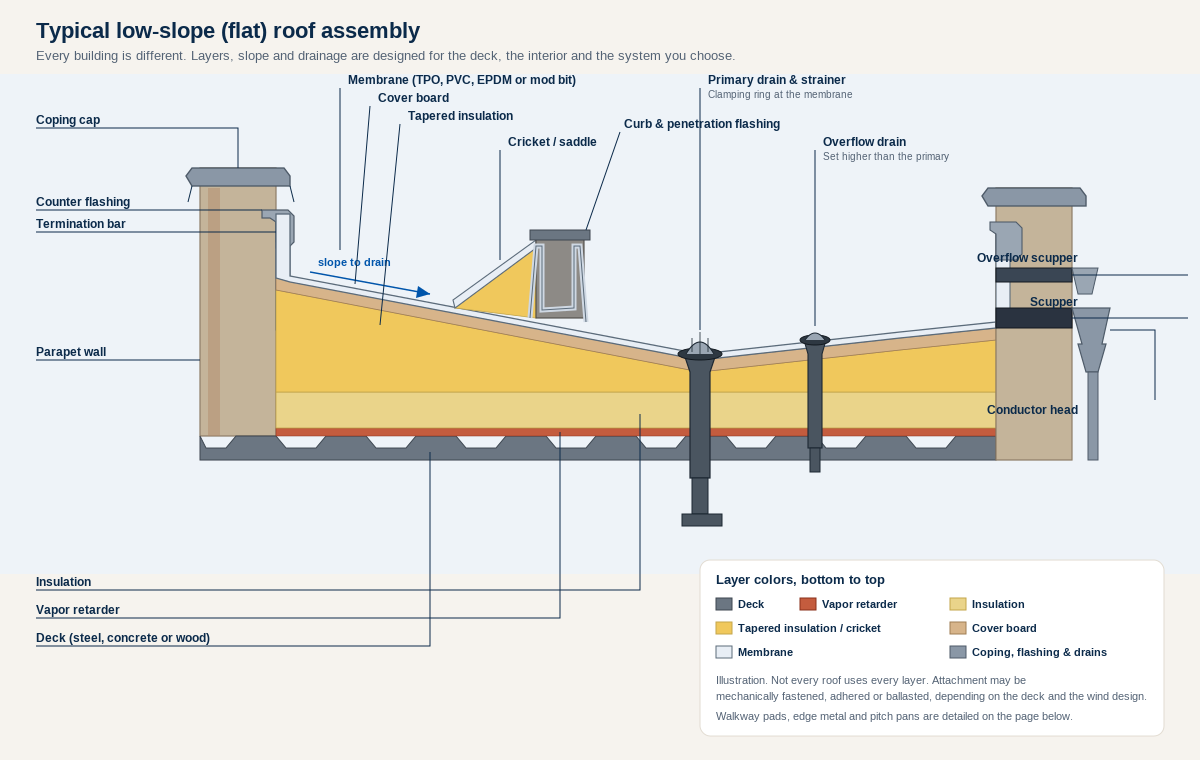
Most leaks start at a detail, not in the middle of the field. This is the assembly we walk, from the deck up, and the drainage that has to work in DFW heat, hail and downpours.
Deck
What it does. The structural surface the roof is built on: steel, concrete or wood.
How it fails. Steel rusts at wet fasteners and at long-standing ponding. Wood rots. Concrete can spall. A soft or corroded deck will not hold fasteners or carry the load of a new system.
How we do it right. We inspect the deck during the survey and at tear-off, replace unsound areas, and match the attachment method to the deck type and the wind design.
Vapor retarder
What it does. Slows interior moisture from moving up into the insulation, especially over kitchens, locker rooms, pools or other humid spaces.
How it fails. A missing, punctured or poorly sealed retarder can wet the insulation from below, which no membrane repair will solve.
How we do it right. We recommend a vapor retarder when the interior and the climate call for one, and we seal it at penetrations, walls and drains so it actually works as a plane.
Insulation and cover board
What it does. Insulation (typically polyiso on DFW jobs) provides R-value and a surface for the membrane. A cover board over the insulation protects against hail, foot traffic and fastener or adhesive stress.
How it fails. Wet insulation loses R-value and can stay wet under a new membrane if it is left in place. Skipping the cover board to save a layer is a common reason membranes puncture and hail claims get messy.
How we do it right. Wet insulation comes out. Dry, sound insulation can sometimes stay, confirmed with a moisture survey and core cuts. See pull tests and core cuts. A cover board is part of the system when the manufacturer and the warranty require it, and we recommend it wherever hail and rooftop traffic are a factor.
Tapered insulation, crickets and saddles
What it does. Tapered insulation builds slope into a "flat" roof so water runs to the drains instead of sitting in ponds. Crickets and saddles are the smaller tapered shapes behind curbs, chimneys and between drains that keep water from collecting on the upslope side of an obstacle.
How it fails. Too little slope, missing crickets behind HVAC curbs, or a saddle that doesn't actually reach a drain leaves standing water. Ponding shortens membrane life and can overload the structure in a heavy rain.
How we do it right. We design the taper layout to the existing drains and overflow, add crickets where water would otherwise stop, and sump the insulation into each primary drain so the clamping ring sits in a low point, not on a flat field.
Primary drains
What it does. Internal (through-deck) drains are the main way most parapet-walled roofs leave the building. A strainer keeps debris out; a clamping ring seals the membrane to the drain bowl.
How it fails. Clogged strainers, a drain bowl set above the surrounding roof, a missing or loose clamping ring, or a broken lead or flashing ring are routine leak sources. A drain that was never lowered into a sump will pond around itself.
How we do it right. We check that every primary drain is clear, sumped and clamped into the new membrane, and we replace failed drain assemblies instead of caulking around them.
Overflow drains
What it does. A second, higher drain (or an overflow scupper) is the safety outlet if the primary drains clog. It keeps a rain event from filling the roof like a swimming pool.
How it fails. Overflows that were never installed, were set at the same height as the primaries, or were blocked leave the roof with no backup. Deep ponding can overload the deck.
How we do it right. We confirm overflow drainage is present and set higher than the primaries, and we add it when a parapet-walled roof doesn't have a safe overflow path.
Scuppers and conductor heads
What it does. A scupper is an opening through a parapet that lets water leave the roof at the perimeter. A conductor head (collector box) catches that water and feeds a downspout.
How it fails. Undersized or rusted scuppers, open corners at the sleeve, and conductor heads that overflow because the downspout is too small or clogged all put water into the wall.
How we do it right. We flash the scupper sleeve into the membrane, size the opening and the downspout for the drainage area, and add an overflow scupper higher in the wall where the building needs a backup path.
Parapet walls
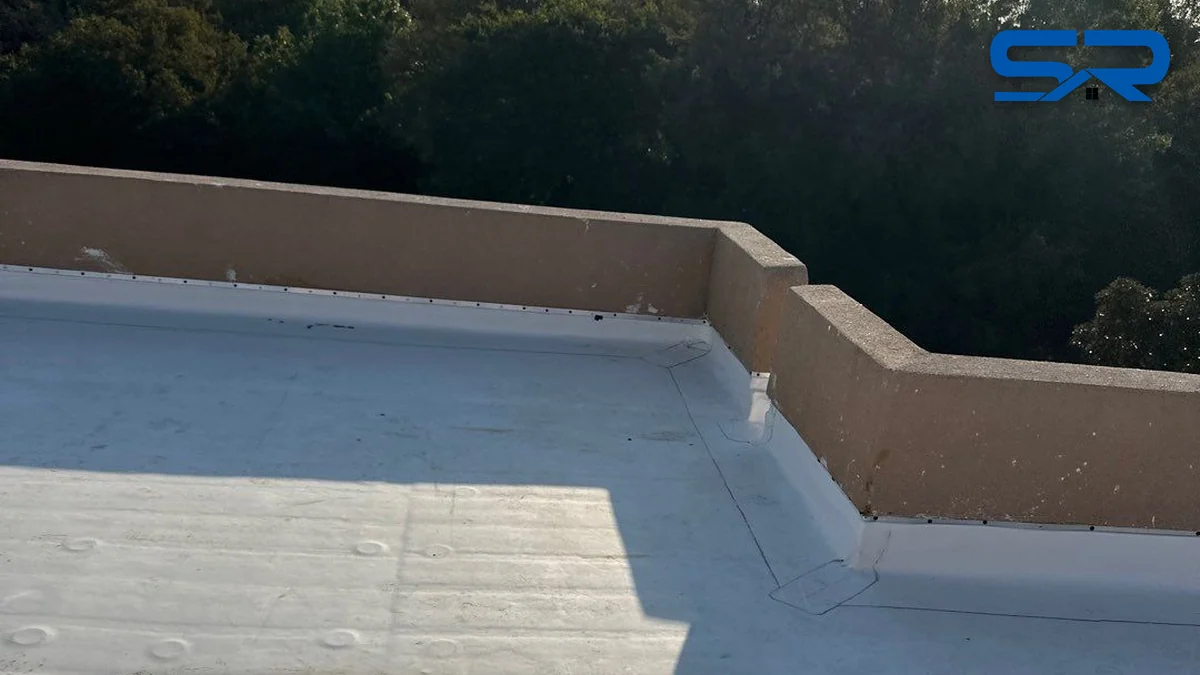
What it does. The low wall around many flat roofs. The membrane has to come up the inside face and be terminated so wind and water can't get behind it.
How it fails. Membrane that stops too low, open inside and outside corners, and wall flashings that have split or pulled loose are among the most common leak points we see, including on low-slope homes.
How we do it right. We carry the membrane up the parapet to the height the system requires, weld or adhere the corners, and terminate it under counter flashing - not with caulk alone. Our TPO work east of Decatur is a good example of parapet wraps on several roof levels; see the project.
Coping cap
What it does. The metal cap on top of the parapet, shedding water off the wall and covering the top of the membrane and flashings.
How it fails. Loose or missing splice plates, open miters, thin metal that oil-cans, and coping with no cleat or underlayment let water into the wall from above.
How we do it right. We install coping with proper joints, a secure cleat, and a break so it drains off the wall, covering the top of the flashing system.
Counter flashing and termination bar
What it does. A termination bar fastens the top of the membrane or flashing to the wall. Counter flashing covers that bar and steps over it so water sheds down the wall, not into the fastener line. See termination bar installation.
How it fails. A term bar with no counter flashing, fasteners that back out, and "caulk is the flashing" details fail in a few seasons of Texas sun and wind.
How we do it right. The membrane is terminated with a bar, then covered with counter flashing let into a reglet or under the coping, so the seal is mechanical, not just sealant.
Edge metal and gravel stop
What it does. On roofs without a full parapet, edge metal or a gravel stop finishes the perimeter, holds the membrane, and is a primary wind-uplift detail.
How it fails. Light-gauge metal, poor splices and missing fasteners let wind peel the edge, which can take a large field of membrane with it.
How we do it right. We install perimeter metal that matches the system's wind rating and the manufacturer's edge detail, with clean splices and a tight membrane hook or termination.
Curbs and penetrations
What it does. HVAC units, skylights, vents and pipes all come through the roof on a curb or a flashing. Each one has to be waterproofed into the membrane.
How it fails. Unflashed or poorly flashed rooftop units, pitch after a unit was moved, and old curb flashings that were cut and never renewed are a leading cause of commercial leaks.
How we do it right. New or reused curbs get a clean flashing boot or wrapped membrane, a cricket on the upslope side where needed, and a finished termination at the unit or lid.
Pitch pans
What it does. A pitch pan (pitch pocket) is a metal or prefabricated box around an irregular pipe or cluster of penetrations, filled with pourable sealer.
How it fails. The filler shrinks, cracks and needs to be topped off. A neglected pitch pan is a leak waiting to happen.
How we do it right. We service existing pans when that's the honest short-term repair. For a permanent detail, when the manufacturer allows it, we prefer a prefabricated boot or a molded flashing instead of a pan that has to be maintained.
Walkway pads
What it does. Pads or pavers protect the membrane where people walk to service rooftop equipment.
How it fails. No walkway means tools, ladders and boots puncture the field. Loose or heat-welded pads that weren't placed on the actual traffic path don't help.
How we do it right. We lay walkway pads on the routes to every unit and access point, using the pad the membrane manufacturer approves so the warranty stays intact.
How the roof is attached
| Method | How it works | Where it usually fits |
|---|---|---|
| Mechanically fastened | Plates and fasteners go through the insulation and membrane into the deck. Seams are welded or adhered over the rows. | Steel decks, many recover jobs, and buildings where speed and a lighter assembly matter |
| Adhered | The membrane (and often the insulation and cover board) is bonded with adhesive or is self-adhered. Fewer fastener penetrations in the field. | Concrete decks, higher wind or hail warranties, and roofs where a smooth, quiet surface is preferred |
| Ballasted | The membrane is loose-laid and held down with stone or pavers. | Some existing ballasted roofs. Less common on new DFW work because of wind, hail and the extra dead load; we tell you when it is and isn't a fit |
The right method depends on the deck, the wind design, the warranty you want and what's already on the roof. We spell out the attachment in the bid.
How we inspect, then plan a permanent fix
- A roof walk plus drone photos and a thermal scan. Every inspection comes with a free digital photo report, so you see what we see. For large or leaking roofs, see commercial roof leak detection and repair and infrared leak detection.
- Core cuts and, where needed, pull or adhesion tests, so we know what's wet and how a new system can attach. See pull tests and core cuts.
- A written plan of action: temporary leak stops if the building is taking on water, then the permanent options - repair, coat, recover or replace - with the system, drainage work and warranty term for each. See multi-option bids.
- Installation to manufacturer specs by certified installers, then the manufacturer's own inspection when an NDL warranty is part of the job. See NDL vs. material vs. workmanship warranties and how a roof qualifies for an NDL warranty.
Warranties: a workmanship warranty from 10 years up to lifetime, depending on the job. Manufacturer NDL (no-dollar-limit) warranties typically run from 10 to 40 years, depending on the manufacturer, the system, and manufacturer approval of the finished job. We do not promise a specific NDL term until that approval is in place. We put the exact warranty for your roof in writing. We offer same-day response in almost every case, and we answer leak and storm calls 24/7 at (817) 733-9228.
Code sections and standards are summarized in plain English. Your building official, the manufacturer's current specification and the warranty document have the final word.
Certified, with 30 years installing every major roofing brand, a family roofing business going back 75 years, and over $80 million in completed roofing projects. 5.0 stars on Google at all three of our offices.
Request a free inspection or call (817) 733-9228. Small repairs are welcome too.